
Our rocket.
A mid-powered competition rocket designed, simulated, and built from scratch by our four-member rookie crew for the American Rocketry Challenge.
Airframe specifications.
Class
ARC Competition
Status
In Design
Length
< 650 mm
Weight
< 650 g
Diameter
> 47 mm
Target Apogee
750 ft
Target Duration
36 – 39 s
Motor Class
Low-end F
Airframe
BT-80 / BT-70
Recovery
Dual-Deploy
Payload
2 Raw Eggs
Airframe schematics.
Two generations of Pyroraptor, modeled and simulated in OpenRocket.
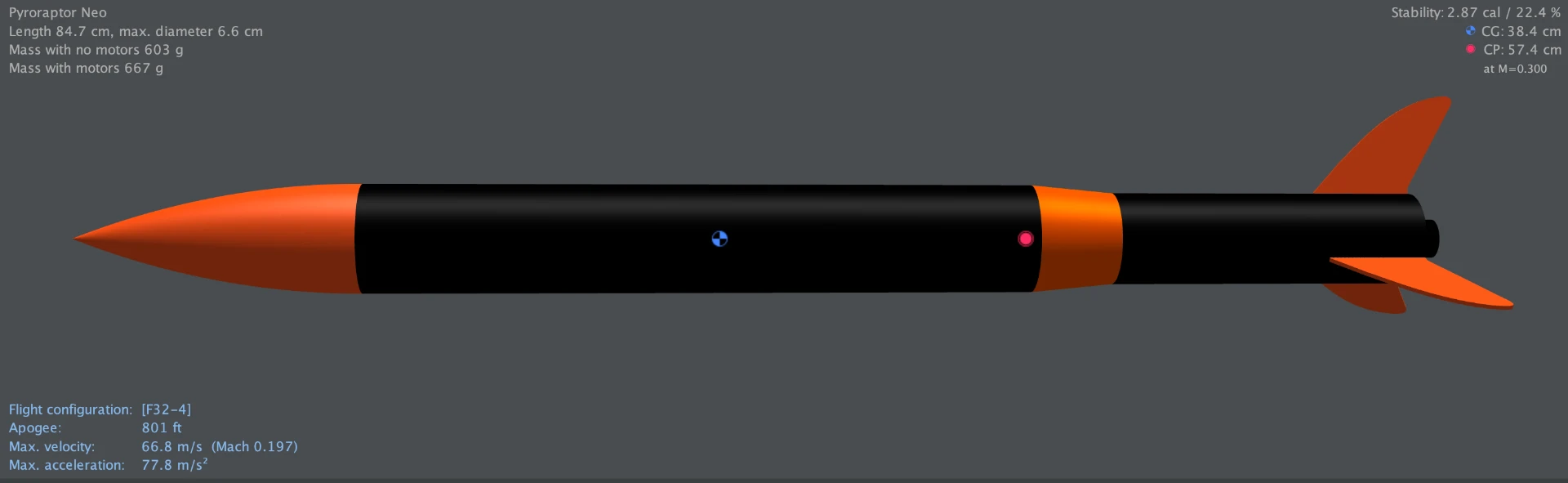
Pyroraptor V1 — First Prototype
Our first flying prototype, built around custom hand-shaped curved fins for added roll stability. 84.7 cm long, 6.6 cm max diameter, 603 g dry and 667 g loaded, flying an F32-4 to roughly 800 ft with a 2.87 cal stability margin.
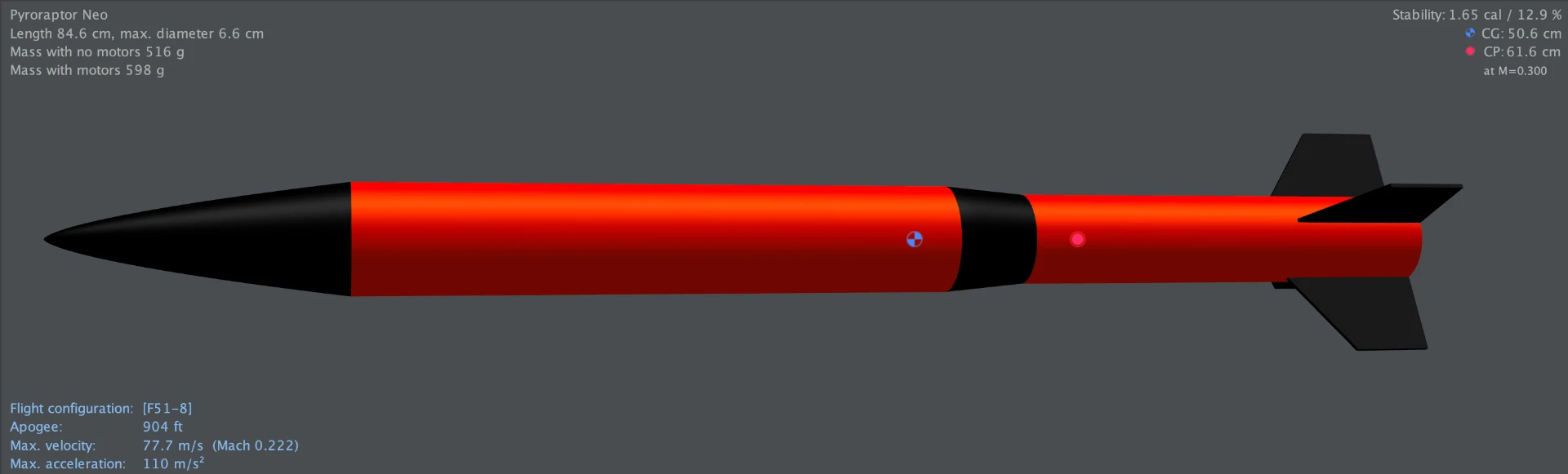
Pyroraptor Neo — Active Control
Neo carries an onboard flight computer that dynamically calculates fin deflection in real time, driving four lightweight servos to trim drag mid-flight and hit an apogee of exactly 800 feet every launch. Recovery uses an Iris ring-deployed parachute for a slow, controlled descent. Lighter than V1 at 516 g dry / 598 g loaded, 84.6 cm long.
Flight Computer
Active fin trim
Actuators
4× servos
Target Apogee
800 ft
Recovery
Iris parachute
Flight simulations.
OpenRocket simulation runs for Pyroraptor on the F32-4 configuration, clustered tightly around our 800 ft target apogee.
| Run | Motor | Vel · Rod | Apogee | Max Vel | Max Accel | To Apogee | Flight | Ground Hit |
|---|---|---|---|---|---|---|---|---|
| 40 | F32-4 | 12.68 m/s | 800.6 ft | 72.26 m/s | 88.17 m/s² | 6.85 s | 37.67 s | 8.29 m/s |
| 41 | F32-4 | 12.68 m/s | 799.2 ft | 72.22 m/s | 88.17 m/s² | 6.84 s | 37.61 s | 8.25 m/s |
| 43 | F32-4 | 12.68 m/s | 804.4 ft | 72.33 m/s | 88.17 m/s² | 6.87 s | 37.82 s | 8.07 m/s |
| 44 | F32-4 | 12.68 m/s | 798.5 ft | 72.20 m/s | 88.17 m/s² | 6.84 s | 37.58 s | 8.31 m/s |
| 45 | F32-4 | 12.68 m/s | 801.7 ft | 72.24 m/s | 88.17 m/s² | 6.86 s | 38.05 s | 7.96 m/s |
| 46 | F32-4 | 12.68 m/s | 800.3 ft | 72.24 m/s | 88.17 m/s² | 6.85 s | 37.66 s | 8.20 m/s |
Note: Simulation 45 logged a large angle-of-attack warning (19.4°).
Design philosophy.
We design for precision, repeatability, and safety. Every component earns its place — nothing flies unless it's been simulated, reviewed, and signed off by the team.
Our airframe favors lightweight composite construction with 3D-printed internal structures. Avionics are kept modular so we can iterate quickly between test flights without rebuilding the rocket from scratch.
The goal isn't just to hit the ARC target — it's to learn the full engineering loop: concept → simulation → fabrication → test → fly.
Current progress.
- 01Complete
Concept & Mission Brief
Team formed, goals locked, ARC rules studied.
- 02In Progress
Preliminary Design
Airframe layout, fin geometry, and recovery system sketches.
- 03In Progress
Simulation & Analysis
OpenRocket sims, stability margins, and altitude tuning.
- 04Upcoming
Fabrication
3D-printed components, airframe assembly, motor mount.
- 05Upcoming
Test Launches
Sub-scale and full-scale flight tests.
- 06Upcoming
Competition Day
ARC national finals, 2026.
Design & telemetry.
Pyroraptor's OpenRocket model, a recent test launch, and the altitude / vertical velocity curve from our latest simulation run.
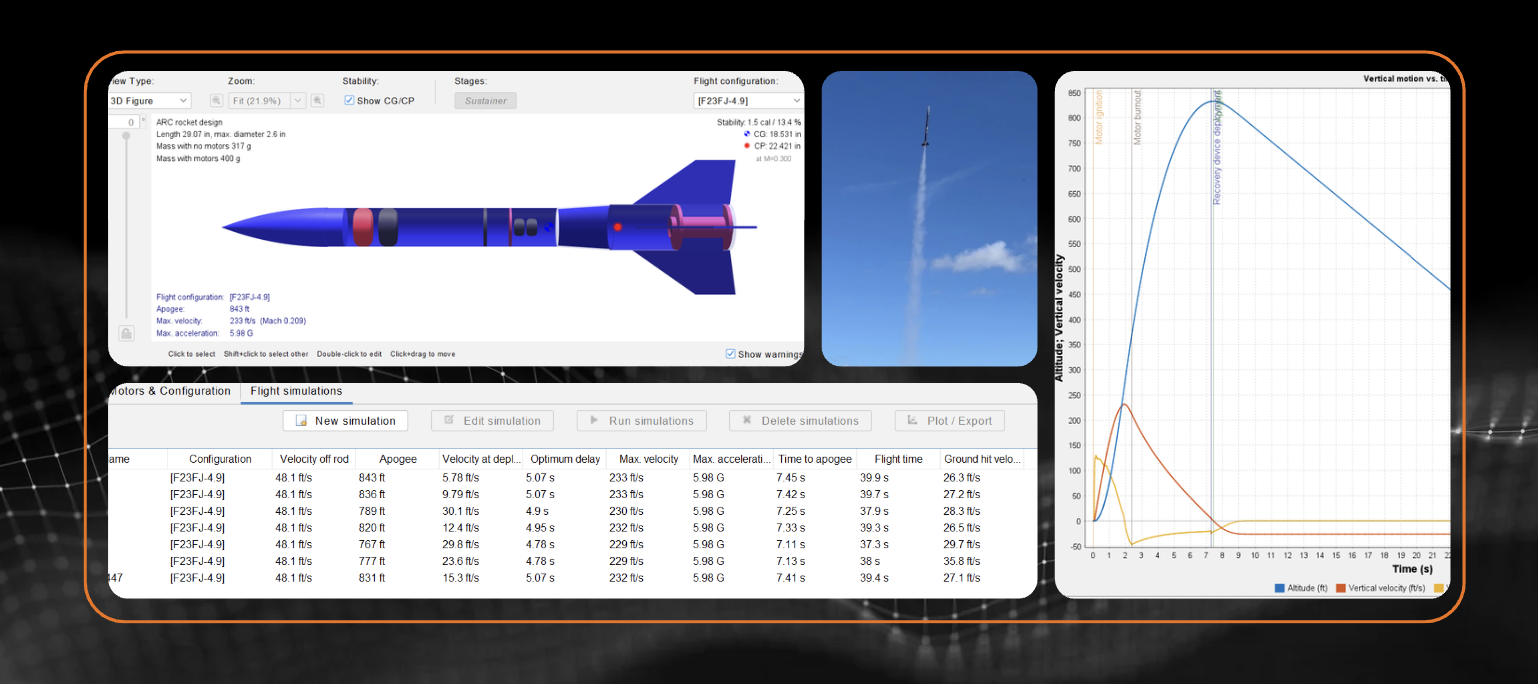
Left: OpenRocket 3D figure with CG/CP markers · Center: in-flight footage · Right: altitude & vertical velocity vs. time.
Help fund this rocket.
Materials, motors, recovery systems, and travel — every part of this build is funded by donations and sponsorships. Help us get to the launch pad.